Cannabis distillate is one of the most potent and versatile concentrates on the market, but not all distillate started life as cannabis. While technically, hemp and cannabis come from the same plant species, cannabis sativa, the distinction is based on their chemical composition and legal classification. As a result, a growing share of the “distillate” sold on today’s market is actually hemp-derived CBD that has been chemically converted into THC-like cannabinoids, or cannabis oil that’s been blended, diluted, or “boosted” with cannabinoids synthesized outside the plant entirely. This isn’t just a quality issue anymore, as of late 2026, it’s a legal one. Federal law now draws a hard line between cannabinoids that occur naturally in the plant and those that are chemically synthesized or manufactured, and a growing number of states are following suit. For brands and consumers alike, knowing how to read a Certificate of Analysis (COA) and spot the fingerprints of conversion is now essential.
Each testing parameter can indicate whether a distillate is an authentic full-spectrum cannabis extract or a converted product wearing a cannabis label.
Cannabinoid Profile
A cannabis plant naturally produces a fairly predictable set of major and minor cannabinoids — THC, CBD, CBG, CBN, CBC, and their acidic precursors (THCA, CBDA, etc.), in ratios that roughly track the plant’s chemotype. Conversion processes disrupt that pattern in specific, detectable ways:
Unnatural cannabinoids and reaction byproducts don’t cleanly produce Delta-8 or Delta-9 THC — it also generates a cocktail of structurally related byproducts that almost never appear in cannabis-derived extract, including exo-THC, Δ8-iso-THC, Δ4(8)-iso-THC, Δ9-iso-THC, and Δ3-THC. A standard cannabinoid panel (THC, Delta-8, CBD, CBN) won’t catch these, so it is important to ensure that expanded cannabinoid panel testing is done to help give the full picture on what cannabinoids are present in a product to provide context and depth.
Here are a couple of examples of COAs for oil that may have been converted:
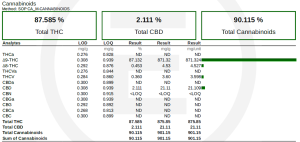
Notice the higher amounts of CBD and Delta-8 THC with little to no presence of any other naturally occurring cannabinoids (such as CBN, C, etc.)
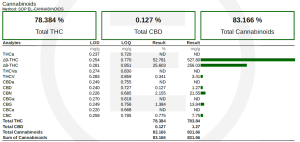
This one is also converted, but it’s a tricky one! Notice how this has a cocktail of cannabinoids with mixes of CBC, CBG, and CBN. However, the dead giveaway here is the high amount of Delta-8 THC and CBD. The lower total cannabinoid count could also be an indicator as this is lower than what we typically see in distillate products.
Here is an example of normal distillate:
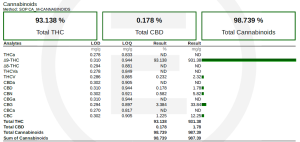
You’ll notice higher CBG, CBC, and a higher total cannabinoid content, with little to no CBD and Delta-8.
Chemical conversion of CBD to Delta-8 THC can also produce small amounts of Delta-9 THC as a byproduct. While the presence of Delta-9 THC alone does not confirm that a product was converted, it may be consistent with a conversion process, especially when considered alongside other analytical findings.
The FY2026 federal appropriations legislation revised the definition of hemp to exclude certain chemically synthesized or manufactured cannabinoids from hemp protections. As a result, regulators are increasingly evaluating not only the cannabinoid content of a product, but also whether those cannabinoids were naturally produced by the plant or created through chemical conversion. Because laws and enforcement vary by jurisdiction, an expanded cannabinoid profile can provide valuable information for both quality assessment and regulatory compliance.
Third-Party Testing
The credibility of every parameter above depends on where the testing came from:
Confirm lab accreditation. Look for ISO/IEC 17025 accreditation, which is the standard for cannabis testing labs and confirms the lab follows validated methods and quality controls.
Terpene Analysis
Terpene testing can provide additional context when evaluating a cannabis distillate, but it should always be interpreted alongside other analytical results.
Rather than focusing only on the total terpene content, examine the individual terpene composition. Products marketed as a specific cultivar may have terpene profiles that are generally consistent with that cultivar, although natural variation and post-processing can influence the final profile.
Distillation often removes naturally occurring terpenes, and some manufacturers intentionally add terpenes back to improve flavor and aroma. For this reason, a simplified or unusual terpene profile does not necessarily indicate a problem.
The concern is when a low or synthetic terpene profile is paired with an unusual cannabinoid profile, since that combination together points toward converted material. Terpene data alone cannot determine whether a product is naturally derived or chemically converted. However, when considered alongside cannabinoid results and other testing data, it can provide additional insight into the product’s overall composition.
Residual Solvents
Solvent testing tells you not just whether a product is below established regulatory limits, but can hint at how it was made:
Different extraction and manufacturing processes may use different solvents. The detection of solvents commonly associated with cannabinoid conversion processes, such as heptane or acetonitrile, may warrant additional review, particularly when considered alongside cannabinoid profile results. However, solvent results alone cannot determine how a product was manufactured.
A passing result indicates the product meets applicable regulatory limits, but reviewing the reported concentrations can provide additional information about the manufacturing process and overall product quality.
Every state cannabis testing program sets action limits for solvents like butane, propane, ethanol, and heptane. A “pass” result close to the legal limit is a different story than one showing non-detectable levels — the former can still indicate a harsher or more chemically intensive process than a simple extraction.
Conclusion
Cannabis conversion isn’t inherently illegitimate — plenty of legal hemp-derived Delta-8 and Delta-10 products are made responsibly and disclosed honestly. The problem is when converted material is passed off as cannabis-derived distillate without disclosure, cutting corners on safety in the process. Spotting that requires looking at the full picture on a Certificate of Analysis cannabinoid results consistent with the claimed cultivation source, clear source documentation with real traceability, and testing from an accredited, verifiable third-party lab.
With federal and state regulations increasingly drawing legal lines around “naturally occurring” versus “synthesized” cannabinoids, this kind of label literacy isn’t just good consumer practice anymore — it’s becoming necessary for compliance. Ask questions, request the full testing panel and favor brands that are transparent about their sourcing and processes. That combination is still the best defense against an inauthentic — or increasingly, an unlawful — product.