A licensed cannabis manufacturer is preparing for another day of production. They start their workday, check their emails, and see that the results for their concentrated product, a distillate†, arrived from the lab the night before.
They open the email anticipating a full day of production. This is the main ingredient in their product; besides flavoring, it is virtually the only ingredient. Production is on hold until clean cannabis lab testing results allow the batch to move forward.
But what happens next is a surprise, and a shock down to the professional core: the batch has failed, showing a trace amount of a “Category I” pesticide designated to trigger an automatic failure. They read the result again, assuming at first that they must have missed something.
This shouldn’t be possible. The cultivator showed a clean analysis before the biomass was purchased, and it was tested again prior to extraction, just to be sure.
But now, plain as day, the results show that the batch may be as good as trash. The team doesn’t have material to work with, deliveries will be late, and they are suddenly scrambling to recoup their losses and produce more oil, all while wondering what the hell could have happened.
What frequently happens is hidden in the manufacturing process itself: a pesticide residue present at a very low level in biomass can become more significant as plant material is processed into a concentrated cannabis product. What may have been below the LOD, or “Limit of Detection,” during initial testing of the biomass can become detectable later in a concentrated product. Cannabis oils, distillates and other concentrates also present different analytical challenges than flower when laboratories quantify pesticide residues.
In the case of a Cat-I, or “Category I,” pesticide, that has historically been a potentially devastating result for a compliance batch. Once a batch actually fails regulatory compliance testing, remediation or reformulation is not simply a matter of adding clean material until the number works. California requires DCC approval of a corrective action plan before remediation, followed by retesting.
No matter how it is handled, the outlook is similar: it can become an expensive and difficult setback.
There is another important qualification to discuss: not every pesticide has historically resulted in an automatic fail-by-detection.
California has referred to the other group as Cat-II, or “Category II,” pesticides. Instead of failure simply because the compound is detected, these pesticides are evaluated against numerical action levels established by the state. A batch can pass residual pesticide testing when detected concentrations remain below the applicable action levels.
For years, California cannabis operators have built business practices around these exact scenarios.
On October 1, 2026, fundamental rules behind those practices will change.
How California Cannabis Lab Testing Got Here
To understand what is about to happen on October 1, it helps to go back to the regulations enacted as California’s regulated cannabis market came online.
California did not introduce every cannabis lab testing requirement at once. Mandatory testing was rolled out in stages.
Beginning January 1, 2018, the first phase included cannabinoids, certain microbial contaminants and Category I residual pesticides. Beginning July 1, 2018, Category II residual pesticide testing and additional requirements were added. More testing requirements followed at the end of that year.
The Category I/Category II framework has remained the basis for California pesticide testing until now.
Under the current rules, a laboratory reports whether a Category I pesticide is detected above its LOD, and if possible, in what amounts (below the limit of quantification, or “<LOQ”, is not uncommon). For Category II pesticides, the laboratory quantitatively measures the residue and compares that concentration with an established action level.
The current list contains 21 Category I pesticides. A tiny detection can therefore represent an enormous business problem, not necessarily because the laboratory found a large concentration, but because it found the substance at all. The universally desired lab result for a Category I pesticide is “ND”, or Not Detected. That regulatory distinction has quietly shaped business decisions throughout the California supply chain.
Processing Can Change the Stakes
This brings us back to the distillate in our opening story.
A low-level contaminant in biomass can become much more significant after extraction and concentration. That possibility has pushed manufacturers to build defensive measures into production: supplier qualification, R&D testing, “micro extractions,” additional quality-control checks and repeated testing before committing material to an expensive production run.
In other words, testing isn’t only about regulatory compliance. It is real-time risk management.
By the time a final result appears, the producer may have already purchased the biomass, paid employees, occupied equipment, completed extraction and distillation, and scheduled production around the finished material. A failure can interrupt all of it, causing delayed orders, rejected inputs, additional testing and an emergency round of production. That is why something measured in fractions of a microgram can have consequences measured in thousands of dollars.
For years, businesses have built testing and production practices around avoiding exactly that outcome. On October 1, California changes the rule that amplified much of that risk.
October 1: Category I and Category II Disappear
California’s new pesticide-testing regulations were approved and filed in July and become effective October 1, 2026. The biggest conceptual change is straightforward:
The Category I and Category II distinction is being eliminated.
Instead, pesticide residues will be evaluated against numerical action levels. During Phase I, each of the 21 former Category I pesticides receives an action level of 0.10 µg/g. Several action levels for pesticides already regulated under the existing system are also being updated.
This represents a significant change in California cannabis lab testing because it changes one of the most important questions asked about a COA.
Under the existing Category I framework, the critical question has effectively been:
Was it detected?
Under the new framework, the question becomes:
How much was detected, and is that concentration above the action level?
That may sound like a subtle distinction, but from a business standpoint, it is not.
The existence of an action level does not mean pesticide contamination is desirable, nor does it give cultivators permission to apply a pesticide simply because a numerical threshold exists. An action level is a laboratory testing threshold, not an approval for pesticide use.
What does change is the consequence of trace detection. For operators who have built production and testing practices around avoiding automatic Category I failures, the new quantification-based framework changes the calculation significantly. Detection is no longer the whole story.
Cannabis Lab Testing and COA Literacy
That makes understanding the numbers on a COA more important than ever.
Under the new framework, it isn’t enough to know that a pesticide was detected. Operators need to understand how much was detected and how that result compares with the applicable action level.
Licensed laboratories must report residual pesticide results quantitatively in micrograms per gram and indicate whether the sample passes or fails. To effectively test the cannabis, labs must establish their limit of quantitation at or below the action level for each pesticide.
That puts three related concepts into play:
LOD (Limit of Detection) tells us whether the laboratory can reliably detect that something is present.
LOQ (Limit of Quantification) tells us the minimum amount the laboratory can reliably quantify.
Action level tells us the regulatory concentration against which the result is evaluated.
For businesses relying on cannabis lab testing, simply seeing anything beyond “ND” will no longer tell the whole story. Now, the number beside it matters.
So What Should Cannabis Businesses Do Before October 1?
The first step is probably the simplest: Talk to the laboratory.
Ask your cannabis lab testing provider how pesticide reporting will look after October 1 and make sure your team understands the new action levels. Review former Category I analytes that have appeared in historical results and determine whether those concentrations would be treated differently under the new regulations. Quality teams, production personnel and purchasing teams should also make sure they are no longer making business decisions based solely on a regulatory distinction that is about to disappear.
Manufacturers should review their supply-chain history and their suppliers’ approaches to pre-screening. It may also be worth revisiting internal R&D testing and quality-control practices to determine which safeguards still provide value under the new framework. The regulatory standard may be changing, but that does not mean a company has to abandon standards it has established for itself.
Now Back to the Distillate…
Let’s go back to the manufacturer from the beginning of our story: the lab detected a tiny amount of a Category I pesticide. Under the framework currently in effect, detection above the applicable LOD creates the failure problem regardless of whether that trace concentration would fall below 0.10 µg/g.
But beginning October 1, those former Category I chemicals receive an action level of 0.10 µg/g. If the quantified residual amount does not exceed that action level, the sample can pass residual pesticide testing under the new framework.
Same chemical. Same analytical finding. Very different regulatory outcome.
And potentially a very different day at the manufacturing facility.
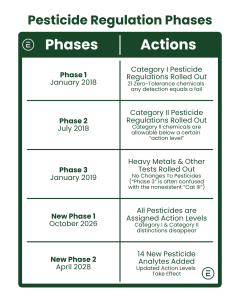
October 1 Isn’t the End of the Story
California divided this regulatory update into two phases.
Phase I begins October 1, 2026. DCC says these initial changes establish action levels that laboratories should be able to implement immediately using current testing capabilities.
Phase II begins April 1, 2028.
That gives laboratories 18 additional months to develop, validate or modify methods for the upcoming requirements. Phase II revises a number of action levels, changes LOQ requirements and expands the scope of California cannabis lab testing with 14 new pesticide analytes.
From an operator’s perspective, adding new analytes to a compliance panel rarely feels like welcome news. But the more useful question is:
How relevant are those analytes to actual California cannabis businesses?
One upcoming addition is pymetrozine, a compound already familiar to some operators through extended pesticide screening beyond California’s required panel.
Another, procymidone, is not registered for use in the United States, yet DCC’s rulemaking record says it has been detected in cannabis grown at both licensed and unlicensed sites. Under Phase II, procymidone receives an action level of 0.02 µg/g for both inhalable and non-inhalable products.
Other new analytes may represent very different levels of practical exposure.
That creates the next job for operators and laboratories: determine which risks are theoretical, which are occurring in the marketplace, and which deserve new quality-control measures before 2028 arrives.
The lesson is not that every new analyte should be treated as an immediate threat. It is that operators now have time to understand which ones may matter to their products, suppliers and production processes, and to adjust testing strategies before those requirements become mandatory.
April 2028 may sound distant, but it gives operators something valuable: time.
Time to understand which of these new analytes may present a meaningful risk, where they may appear, and whether establishing testing protocols for them early makes sense for the business.
At Encore Labs, those are the conversations worth having before a number on a COA becomes a much more expensive conversation later.
† Distillate: Cannabis distillate is a highly purified oil in which plant compounds, impurities and aromatic compounds have largely been removed to concentrate cannabinoids such as THC or CBD.